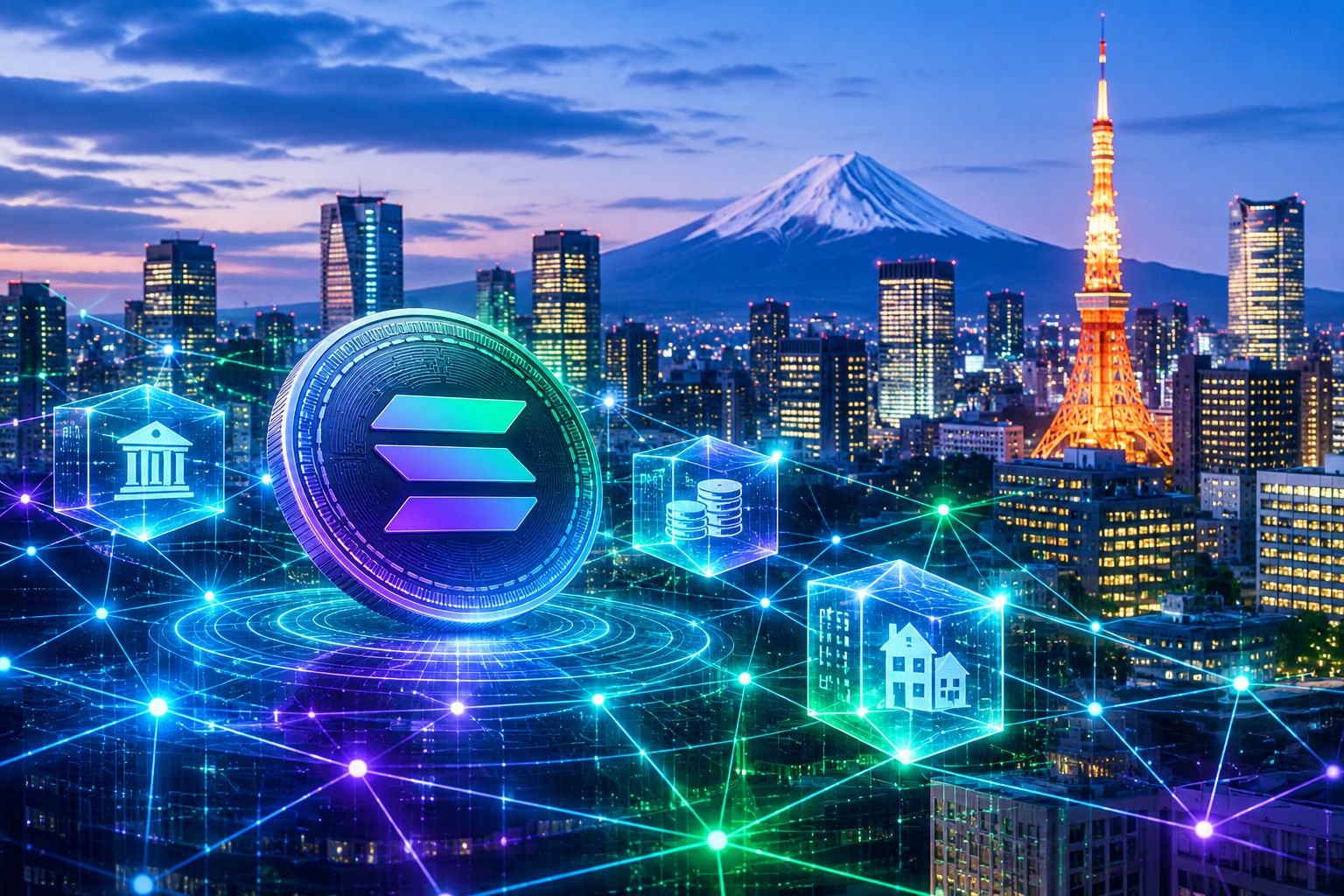
Japan’s financial sector is taking another step toward blockchain-based finance. SBI Holdings, Sumitomo Mitsui Financial Group (SMBC Group) and the Solana Foundation announced on November 25, 2026, that their joint venture has begun full-scale operations as SBI Solana Global Co., Ltd. The initiative is designed to connect established financial institutions with Solana’s blockchain ecosystem, with a focus on stablecoin payments, tokenized financial and real-world assets, and on-chain asset management.
The announcement is significant because it places a major Japanese financial-services network alongside a public blockchain ecosystem in a coordinated business structure. Rather than presenting blockchain only as a platform for cryptocurrency trading, the partners are targeting practical financial services that could link payments, investment products and asset management across borders.
What the SBI Solana Global announcement means
According to the joint news release, SBI R3 Japan Co., Ltd. has transitioned to the new joint-venture structure and commenced full-scale operations under the SBI Solana Global name. SBI Holdings and SMBC Group bring financial expertise and business networks, while the Solana Foundation is collaborating to support the venture’s development.
The stated ambition is to build an on-chain digital economy originating in Japan and extend it across Asia and global markets. In this context, “on-chain” means that activities such as issuing, transferring, settling or managing certain assets can be represented and carried out through blockchain-based systems.
The companies describe Solana’s infrastructure as high-speed and low-cost, but the announcement does not promise a specific transaction-volume target, launch date for individual products or guaranteed cost savings for customers. Those details will depend on the services the venture develops and the rules that apply to each use case.
Four areas the new venture plans to develop
1. Stablecoin payment and remittance rails
The first focus is payment infrastructure using stablecoins. These are digital tokens designed to maintain a stable value relative to a reference asset, commonly a national currency. The partners say they want to explore domestic and cross-border payments and remittances, as well as newer use cases such as micropayments made by AI agents.
For businesses, blockchain-based payment rails could eventually offer another way to move value between markets and systems. However, practical adoption will depend on compliance checks, custody arrangements, liquidity, redemption processes and the legal treatment of the stablecoins involved. The announcement sets out a business direction; it does not mean that every proposed payment service is already available to the public.
2. Tokenization of financial assets
The second area is bringing assets such as bonds, investment funds and loan receivables onto blockchain networks. Tokenization represents rights or interests in an asset through digital tokens. If designed with appropriate legal and operational safeguards, this approach may support the issuance and distribution of financial products and could broaden access for eligible investors.
Tokenized securities still need clear ownership records, investor protections, reliable servicing and compliance with securities laws. A token does not automatically remove the legal obligations attached to the underlying asset. The venture’s challenge will be to connect blockchain settlement with the established systems that financial markets rely on.
3. Tokenization of real-world assets
The third focus covers commodities, rights and other physical or non-financial assets. The partners say they intend to explore digital representations that can support new investment and distribution markets, alongside mechanisms for checking authenticity and tracing assets.
This area is often called real-world asset (RWA) tokenization. Its promise is easier digital recordkeeping and potentially more flexible distribution. Its hardest questions are often outside the blockchain itself: proving that an asset exists, confirming who legally controls it, keeping records accurate and explaining what rights a token holder actually receives.
4. On-chain asset management
The fourth business area is asset management services using stablecoins and tokenized assets. SBI Solana Global says it will explore and commercialize services in this field. The longer-term vision is to connect payments, asset issuance, distribution and management into a more integrated on-chain financial ecosystem.
Why the partnership matters for blockchain adoption in Asia
Large financial institutions can bring relationships with businesses, investors and regulators that a technology project may not have on its own. A blockchain ecosystem can, in turn, provide programmable infrastructure for moving and recording digital assets. The partnership attempts to combine these strengths rather than treating traditional finance and decentralized networks as separate worlds.
Japan is the venture’s starting point, but the announcement explicitly describes an ambition to expand across Asia and connect with global on-chain markets. Cross-border payments and tokenized assets are natural areas for such an approach because financial activity often involves multiple institutions, jurisdictions and operating hours.
Still, regional expansion will not be automatic. Each market has its own rules for payments, securities, custody, data protection and digital assets. The venture will need to demonstrate that its services can meet those requirements while offering a clear benefit over existing financial infrastructure.
What to watch next
The next meaningful milestones will be concrete product announcements: which stablecoins and payment corridors are supported, what tokenized assets are issued, who can use the services, and how custody and investor protections are handled. Businesses and market participants will also want clarity on fees, settlement arrangements, interoperability and the role of regulated financial intermediaries.
It will also be important to distinguish between the venture’s stated plans and services that have actually launched. The November 25 announcement confirms the new company’s full-scale operational start and identifies its four business priorities. It does not provide a timetable for every product or establish that all four areas are already live.
Bottom line
The launch of SBI Solana Global is a notable blockchain industry development because it brings major Japanese financial groups and the Solana ecosystem into a shared effort focused on real financial use cases. Stablecoin payments, tokenized securities, real-world assets and on-chain asset management could become important parts of the next phase of digital finance—but their success will depend on regulation, trust, security and practical customer demand.
For now, the announcement is best understood as the start of a strategic business push, not proof that a new financial system has already arrived. The products the venture delivers, and how well they connect blockchain technology with existing financial safeguards, will determine whether its ambitions translate into lasting adoption across Asia.
Source
Editorial note: This article is for informational purposes only and is not investment advice. It does not recommend buying or selling SOL or any other digital asset.